
What is Agentic AI Automation? A Complete Guide for Businesses in 2026


TL;DR — Key Takeaways
- • Move beyond simple chatbots. Discover how autonomous Agentic AI is transforming enterprise workflows, decision-making, and ROI in 2026.
- • This article covers ai strategies strategies for businesses using AI automation.
- • Zappify.io provides the all-in-one platform to implement these strategies — from CRM to AI agents.
Agentic AI automation is an advanced form of artificial intelligence where systems operate autonomously to achieve complex goals. Unlike traditional automation that follows rigid if/then rules, agentic AI can reason, make decisions, use external tools, and adapt to unexpected situations to complete multi-step workflows without constant human intervention.
For years, businesses have relied on automation to speed up repetitive tasks. But as we move deeper into 2026, the landscape has fundamentally shifted. We are no longer just automating clicks and data entry; we are automating complex decision-making processes.
If your business is still relying exclusively on rigid, rule-based workflows, you are likely leaving massive efficiency gains on the table. The future belongs to systems that can think, adapt, and execute.
The Evolution of Automation: Why Agentic AI is the Standard in 2026
To understand the power of agentic AI, we first need to look at how we got here. In the past, automation was strictly linear. It required a human to map out every possible scenario in advance.
From "Trigger-Action" to "Reasoning"
Traditional automation operates on a "Trigger-Action" framework. If X happens, then do Y. This is incredibly useful for moving data between apps, but it breaks the moment it encounters an exception. If a customer sends an email that doesn't perfectly match the expected format, the automation fails.
Agentic automation operates on a "Reasoning" framework. Instead of giving the AI a rigid set of instructions, you give it a goal, a set of guidelines, and access to tools. The AI (powered by advanced Large Language Models, or LLMs) then figures out the best path to achieve that goal.
It can read an ambiguous email, determine what the customer actually wants, query a database to find the answer, and draft a personalized response—all without needing a human to pre-program that specific path.
What Makes an AI "Agentic"? Key Characteristics
Not all AI is agentic. A simple chatbot that regurgitates FAQ answers is not an agent. To be considered truly agentic, an AI system must possess several core capabilities:
- Autonomy: The ability to operate independently over extended periods. Once given a goal, the agent can break it down into smaller tasks and execute them sequentially without waiting for human prompts.
- Reasoning and Planning: The capacity to analyze a situation, weigh different options, and formulate a multi-step plan to solve a complex problem.
- Tool-Use: The power to interact with external software. An agentic AI can browse the web, query your CRM, send emails, or trigger API calls to gather information and execute actions.
- Memory and Context: The ability to remember past interactions and learn from them. Agentic systems maintain context across long conversations and complex workflows.
- Adaptability: The skill to handle exceptions. If a tool fails or a user provides unexpected input, the agent can course-correct and try an alternative approach.
Practical Use Cases: Agentic AI in Action
How does this translate into actual business value? Here are three distinct ways agentic AI is transforming enterprise workflows in 2026.
1. Autonomous Customer Success and Resolution
Traditional chatbots deflect tickets; agentic AI resolves them. Imagine a customer asking for a refund because their shipment was delayed. A standard bot would just point them to the refund policy.
An agentic AI will check the shipping API, verify the delay, review the customer's lifetime value in the CRM, calculate an appropriate compensation offer, process the partial refund, and email the customer an apology—completely autonomously, following your exact business logic.
2. Intelligent Lead Qualification and Pipeline Management
Sales teams waste countless hours chasing unqualified leads. Agentic AI acts as a tireless Sales Development Representative (SDR). When a new lead enters the system, the agent doesn't just send a generic drip email.
It researches the lead's company online, analyzes their recent news, crafts a hyper-personalized outreach message, and engages them in a two-way conversation. It can handle objections, answer specific product questions, and only hand the lead over to a human closer when they are fully qualified and ready to buy.
3. Dynamic Scheduling and Resource Allocation
Managing calendars and resources across large teams is a logistical nightmare. Agentic AI can take over complex scheduling that requires balancing multiple constraints.
If an urgent project comes in, the agent can analyze the current workload of your team, identify who has the right skills and availability, automatically reschedule lower-priority meetings, and allocate the new tasks—ensuring maximum productivity without burning out your staff.
The Essential Role of the Human-in-the-Loop
With all this autonomy, you might wonder if humans are becoming obsolete in these workflows. The answer is a resounding no. In fact, human oversight is more critical than ever.
Agentic AI is powerful, but it is not infallible. Complex systems can still hallucinate or misinterpret ambiguous business rules. This is why the "Human-in-the-Loop" (HITL) model is the gold standard for enterprise AI implementation.
In a HITL setup, the AI handles the heavy lifting—researching, drafting, and preparing actions. However, for high-stakes decisions (like issuing large refunds or sending contracts), the agent pauses and requests human approval.
This ensures you maintain absolute quality control while still reaping 90% of the efficiency benefits. The human transitions from being the "doer" of the work to the "editor and approver," drastically increasing their output and strategic value.
Conclusion: Preparing Your Business for Agentic Automation
The transition from manual work to trigger-based automation was a massive leap forward. The shift to agentic AI is an even bigger one. Businesses that adopt these autonomous systems will operate with a speed, efficiency, and scale that traditional organizations simply cannot match.
The technology is no longer science fiction; it is here, and it is accessible. The only question is whether your business will lead the charge or be left playing catch-up.
Ready to transform your operations? Audit your current workflows today to identify bottlenecks, repetitive tasks, and complex decision points. Discover where Agentic AI can be integrated into your business for maximum ROI and unstoppable growth.
Frequently Asked Questions
How much does AI automation cost for a Philippine business?
AI Zappify starts at P2,899 per month or P28,990 per year (2 months free). This includes AI chatbot, CRM, appointment booking, email marketing, and social media management — 10 tools in one platform. A 14-day free trial is available with no credit card required.
How long does it take to set up AI automation for my business?
Most businesses are up and running in under an hour. You connect your Facebook Page, set your business hours and services, link your calendar, and the AI is ready. For businesses that want done-for-you setup, Zappify Services handles everything end-to-end.
Can AI automation work with Messenger, SMS, and Viber?
Yes. AI Zappify connects to Facebook Messenger, Instagram DMs, SMS, and Viber in one unified inbox. The AI responds in English, Taglish, or Tagalog — 24/7, instantly. Every conversation is logged in your CRM for follow-up.
Browse by Category
Related Articles
AI Automation for Medical Clinics in the Philippines: Never Lose a Patient
AI automation for medical clinics in the Philippines answers patient inquiries instantly, books appointments automatically, and cuts no-shows with smart reminders — so your secretary never loses a patient again.
AI Automation for Optical Clinics in the Philippines: Turn Past Customers Into Repeat Revenue
AI automation for optical clinics in the Philippines answers frame and eye exam inquiries instantly, books exams automatically, and recalls past customers at 12, 18, and 24 months — turning your dead customer list into repeat revenue.
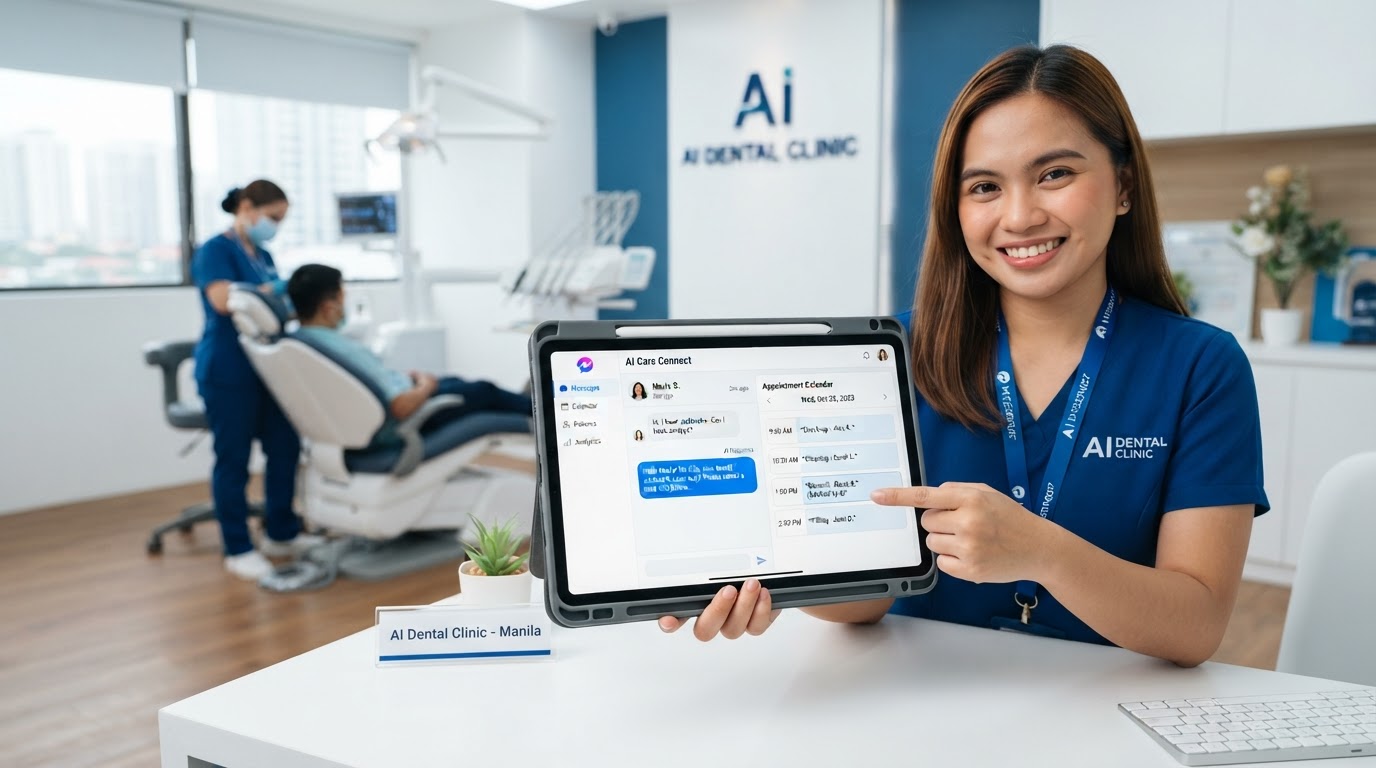
AI Automation for Dental Clinics in the Philippines: Never Miss a Patient Again
AI automation for dental clinics in the Philippines answers Messenger inquiries instantly, books appointments automatically, and cuts no-shows with smart reminders — so your front desk never loses a patient again.